
Dispensationalists and Christian Zionists often talk as if God still owes something to carnal Israel, something that can only be received in the modern era by the contemporary state of Israel. But everything God promised Abraham was fulfilled in Bible times. The notion that God still owes the carnal descendants of Abraham something is a lie. Israel, the descendants of Abraham, were given the promised land, they lived in that land for over six centuries.
The Book of Joshua is almost entirely a description of the battles fought and the territory won for each of the twelve tribes of Israel. The result was this:
“So Joshua took the entire land, in keeping with all that the LORD had spoken to Moses. And Joshua gave it as an inheritance to Israel according to the allotments to their tribes. Then the land had rest from war.” Joshua 11:23
“And the Lord gave unto Israel all the land which he swore to give unto their fathers; and they possessed it, and dwelt therein.” Joshua 21:43 (emphasis added)
Please take careful note of this Bible truth: God gave Israel ALL the land He had promised to Abraham and his descendants to Israel; they possessed it and they lived in it. Everything promised was delivered. God keeps His promises, and He kept the promise He made to Abraham.
Israel Under the Judges
After Joshua completed the conquest of Canaan in around 1,380 BC, Israel was ruled by judges for some 350 years. God wanted Israel to be free and self-governing, living under the law of Moses, aided in doing so by prophets, priests, and judges. It was not God’s will for Israel to have a king (1 Sam. 8).
During the time of judges, the sanctuary was set up and functioning in Shiloh, about 20 miles north of Jerusalem in the hill country of Israel. (Joshua 18:1). All Israel dwelt in the promised land during the time of the judges with their religious ritual intact.
To be sure, Israel had problems during the period of the judges, including idolatry (Judges 10:6), gross immorality (Judges 19), and civil war among the tribes (Judges 20). Israel’s sovereignty during this time depended upon their faithfulness to God. When they followed God, they were strong and self-governing. But when idolatry became preponderant, God would allow one of Israel’s neighbors, e.g., the Philistines, to conquer them and rule over them until they repented of their idolatry and returned to the Lord. (Judges 10:6-16). But the period of the Judges must be included in the time in which the twelve tribes of Israel lived in the land promised to Abraham.
“The Lord gave unto Israel all the land which he swore to give unto their fathers.”
The United Kingdom of Israel
Although it was not God’s will for Israel to have a king, God relented to the popular demand for a king (1 Sam. 8:19), authorized the prophet Samuel to find and anoint a king, and arranged a meeting between Samuel and Saul (1 Sam. 9:17). Around 1050 BC, Samuel anointed Saul as Israel’s first king. The united kingdom continued through David and Solomon. David’s reign was marred by his sins of adultery and murder, which caused a civil war and much contention over who would succeed David on the throne.
Solomon had many achievements, the greatest of which was to build a magnificent temple to replace the mobile tabernacle/sanctuary, but the latter part of Solomon’s reign was ruined by his apostasy, which was caused by his union with hundreds of idolatrous foreign wives and concubines. The united kingdom of Saul, David, and Solomon lasted 120 years, until around 930 BC.
The Divided Kingdom of Israel and Judah
Solomon’s son Rehoboam refused to lower taxes, which Solomon, during his decadent phase, had raised too high (1 Kings 12:1-15). Rehoboam even threatened to raise taxes further, which enabled Jeroboam to wrest away the northern 10 tribes, forever dividing the kingdom of Israel. The divided kingdom lasted about two centuries, with the southern kingdom, consisting of Judah and Benjamin, having its seat in Jerusalem, and the northern kingdom having its capital in Samaria.
Because the temple, the center of the religious ritual, was in Jerusalem in the territory of Judah, the northern kings erected golden bulls at Bethel and Dan, creating a false, syncretistic religion that combined elements of pagan fertility cults with the religion God had given Israel through Moses. The northern dynasty led its people ever deeper into apostasy until finally, in 721 BC, the Assyrians destroyed the northern Kingdom.
From the beginning of the period of the judges until the ten tribes were lost to history was over 650 years. Six hundred fifty years is a long time. In a few days, we in the United States will celebrate the 250th anniversary of being a sovereign nation on the continent of North America. But we would have to continue another four centuries to be here as long as Israel was in the promised land. Clearly, Israel had a long run in the land promised to them.
Carnal Israel reduced to the “Jews,” a remnant of Judah and Benjamin
After 721 BC, carnal Israel—defined as the twelve flesh-and-blood tribes descended from the 12 sons of Jacob—no longer existed. What was left was the tribe of Judah and the small tribe of Benjamin. This remnant was further whittled away when it was taken into captivity in Babylon in 586 BC. Many who went into captivity did not return; some stayed in Babylon and some went even further east. The book of Esther tells a story about the Jewish expatriate community in Susa, in Persia (modern Iran), which is 300 miles east of Babylon.
The term “Jew” is derived from the name of the surviving tribe, “Judah.” After the return from the Babylonian captivity, the land they occupied, within a few miles of Jerusalem, became known as “Judea.” The Jews in Judea were mostly killed or scattered during the First Jewish War, in which the city of Jerusalem and Herod’s Temple were destroyed, and in the Third Jewish War, called the “Bar Kokhba Revolt.” After these rebellions against Rome, little was left of the Jews.
Modern Jews, many of whom, according to Jewish writers Arthur Koestler and Schlomo Sand, are converts to Judaism from eastern Europe and western Asia, are not Israel. They are neither carnal Israel, which consisted of all 12 tribes, nor spiritual Israel, who are believers in Jesus Christ, Christians, and who are symbolized by all 12 tribes (see, Revelation 7:5-8).
What is the “river of Egypt”?
Some argue, based upon Genesis 15:18, that God had promised Israel all the land from the Nile to the Euphrates, but is that true? Here is the passage:
“On that day the Lord made a covenant with Abram and said, ‘To your descendants I give this land, from the river of Egypt to the great river, the Euphrates’.” Gen. 15:18.
The Nile is not named; rather, the passage refers to “the river of Egypt.” Please notice something interesting: the Euphrates is described as a “great river,” and it is, but the “river of Egypt,” which is alleged to be the Nile, is described only as a “river.” Do you see the problem? The Nile is an even greater river than the Euphrates, but the text does not reflect that.
It turns out that the word “river” is not an accurate translation; a better word is “wadi,” which is found in most English translations:
“On that day the Lord made a covenant with Abram and said, ‘To your descendants I give this land, from the Wadi of Egypt to the great river, the Euphrates –”
The watercourse in question is a wadi, that is, a dry riverbed that becomes an active stream only during rainy seasons. No one would ever call the Nile a “wadi”! A popular commentary states:
“The Wadi of Egypt, also known as the Brook of Egypt, is a significant geographical and historical term found in the Bible, often associated with the southern boundary of the Promised Land. In Hebrew, it is referred to as “Nachal Mitzrayim” (נַחַ מִצְרַיִם), which translates to “Brook of Egypt.” This term is used to describe a seasonal riverbed or valley that marks the southwestern border of the land promised to the descendants of Abraham, Isaac, and Jacob. See, Gen. 15:18; Num. 34:5; Joshua 15:4; 1 Kings 8:65.”
Even the Scofield notes, which have done much mischief by promoting the gross heresy of dispensationalism and Christian Zionism, do not promote the false idea that the “river of Egypt” is the Nile. The Scofield comment on Genesis 15:18 is:
“Not the Nile, but a small stream south of Gaza, known as the Wadi el Arish.”
So there really is no controversy over the location of the southern boundary of Israel. It was never the Nile, and no competent Bible student has ever argued (in good faith) that it was the Nile. It was a (usually) dry riverbed known as the Wadi of Egypt, the Brook of Egypt, or the Wadi el Arish.
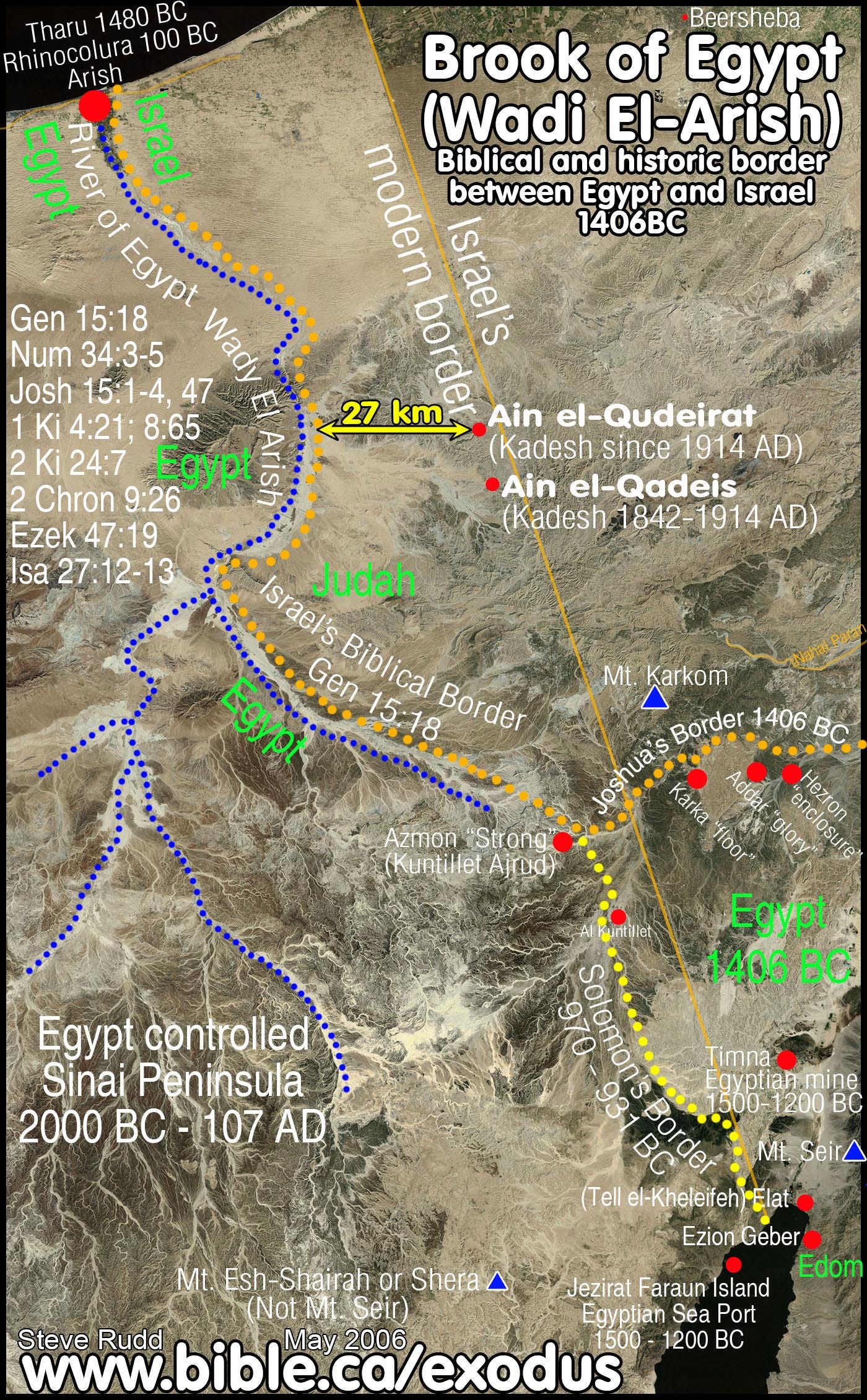
First Kings 8:65 tells us that, indeed, Solomon ruled from Lebanon down to the Wadi of Egypt:
“So Solomon observed the festival at that time, and all Israel with him—a vast assembly, people from Lebo Hamath to the Wadi of Egypt.”
Lebo Hammath seems to correspond to the modern city of Hama, which is in northwestern Syria, north of Lebanon. 1 Kings 4:21 tells us that Solomon, through client kingdoms, ruled all the way to the Euphrates River:
“And Solomon ruled over all the kingdoms from the Euphrates River to the land of the Philistines, as far as the border of Egypt. These countries brought tribute and were Solomon’s subjects all his life.”
All the territorial promises made to Abraham and his descendants were fulfilled. All the land promised them was given them. Solomon, at the height of the united kingdom of Israel, ruled from the Euphrates to the Wadi of Egypt, the Brook of Egypt, which was the southern boundary of Israel.
The “Greater Israel Project”
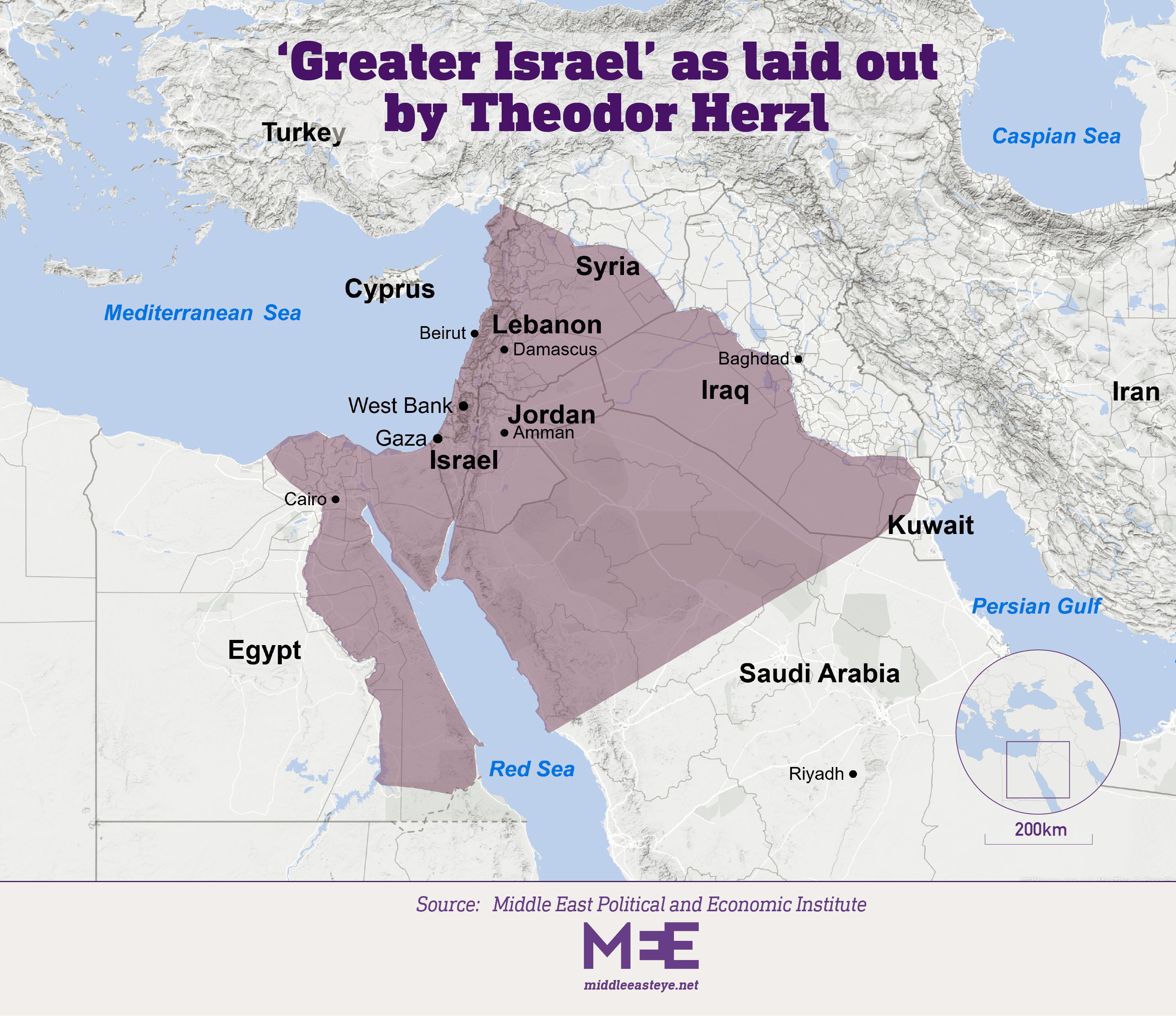
Since it is obviously not in the Bible, where did the idea that Israel is owed land from the Euphrates to the Nile comes from? It came from modern Zionists, those who, in the late 19th Century, planned to establish a Jewish state in the Levant. It was these men, Theodor Herzl and others, who came up with the idea of “Greater Israel.” Today, Benjamin Netanyahu and others in the Likud party are keeping alive “the greater Israel project.” If you study the map below, you will see that the “greater Israel project involves stealing territory from Egypt, Jordan, Saudi Arabia, Lebanon, Syria, Turkey, Iraq, and even a sliver of Kuwait.
Did you ever wonder why the flag of Israel has two blue stripes, one at the top and one at the bottom? The blue stripe on the bottom represents the Nile; the blue stripe at the top represents the Euphrates. Although Israel did not become an independent nation until 1948, the flag was adopted at the First International Zionist Conference in Basel, Switzerland, in 1897.
Obviously, the Zionists who designed the flag of Israel in the late 19th Century, including Boston attorney Isaac Harris, were already planning on a “greater Israel” that stretched from the Nile to the Euphrates. (The six-pointed star in the middle of the flag, the Star of Remphan or Rephan, has nothing to do with biblical David, but that’s a story for another day.)
The Tucker Carlson - Mike Huckabee Clash
The false notion that God promised Israel everything from the Nile to the Euphrates was at the center of an infamous interview by Tucker Carlson of Mike Huckabee, a dispensationalist preacher from Little Rock, Arkansas, who currently serves as the U.S. Ambassador to Israel. Neither man acquitted himself well on this issue. Carlson was so consumed with righteous indignation at the ludicrous notion that God’s promises to Abraham apply to the atheistic, socialist Jews who founded modern Israel that he neglected to do his homework regarding what the Bible teaches on the topic.
But Huckabee did worse. His first calling was gospel ministry, but he did not know that the “Nile to the Euphrates/Greater Israel Project” idea is not found in the Bible but rather is a notion spun up by 19th Century Zionists. Then, assuming it was in the Scriptures, Huckabee volunteered that maybe those should be modern Israel’s boundaries. That’s a dumb thing for Huckabee the preacher to say, but a dangerous thing for Huckabee the U.S. diplomat who speaks on behalf of the United States, to say. Mike Huckabee created a diplomatic contretemps with Egypt, Jordan, Syria, Iraq, Lebanon, Saudi Arabia, Kuwait, and even Turkey, by stating that modern Israel has a biblical right to their sovereign territory.
The Bottom Line
God kept his real estate promises to Abraham, Isaac and Jacob. Physical or carnal Israel—the twelve tribes descended from Jacob, who was appropriately renamed Israel (“he struggles with God”)—received all the land promised them. They took that land and lived on it for over 650 years. There is no ground for the supposition that some of the land promised to Israel was not actually given them in Bible times. This must be understood, or else one becomes vulnerable to the lies of the “Christian” Zionists.